

Puerto Rico

The Commonwealth of Puerto Rico is an unincorporated U.S. territory in the Caribbean Sea. It consists of the largest and most populous island, Puerto Rico; two smaller inhabited islands, Vieques and Culebra; and 140 other small uninhabited islands. The total combined landmass area is 3,515 mi2 (9,104 km2). [1]
The waters of Puerto Rico host 1,300 mi2 (3,370 km2) of reef. [2]
Puerto Rico’s reefs are home to
65 hard coral species
112 soft coral species
242 reef fish species
[2]

Reef Threats


Coral Bleaching
Stony Coral Tissue Loss Disease
Nuisance Algae in Coral Reef Environments
Learn more
- Coral bleaching continues to threaten corals in Puerto Rico as ocean temperatures rise. In the summer of 2023, Puerto Rico’s reefs were hit especially hard by coral bleaching and resulting mortality. Mitigation efforts were also limited due to a lack of funding and resources. Since then, a coral bleaching protocol has been developed and tested, which includes training volunteers to assist with bleaching monitoring. [3]
Learn more
- Stony Coral Tissue Loss Disease (SCTLD) is a highly contagious coral disease first detected in Florida in 2014. Since then, it has spread throughout the Caribbean. In Puerto Rico, SCTLD first appeared in Culebra in October 2019. Reef surveys showed that this disease rapidly spread from 4% of the reef to 50% in just 1 month. This disease is now spread throughout Puerto Rico and has impacted reefs on the eastern, northern, and southern coasts. [4]
- Although the cause of this disease has not yet been pinpointed, natural resource managers continue to monitor and respond to SCTLD outbreaks around Puerto Rico.
- For more information on this disease and for resources on how you can help stop the spread of SCTLD in Puerto Rico, please visit: https://www.drna.pr.gov/coralpr/coral-diseases/
Learn more
- In Puerto Rico, sea urchins of the genus Diadema play a critical role on the reef by eating algae that would otherwise smother juvenile corals. Unfortunately, Diadema urchins experienced a mass die-off in the 80s, which has allowed algae to overgrow and threaten reefs island-wide. [5]
- Some reefs have especially high concentrations of microalgae and macroalgae (Ramicrusta and Cottoniella filamentosa) that overtake and kill corals. [6]
- Diadema urchins continue to face die-offs, although the cause is still unclear. Reefs near harbors and marinas tend to be especially susceptible to this threat. [6]
- To help mitigate these die-offs, Puerto Rico started a land-based nursery in Ceiba in 2023 to rescue sickly Diadema urchins as well as SCTLD-susceptible coral species. [7]
Reef Protections
- Puerto Rico has several marine protected areas (MPAs) around the island to safeguard its coral reefs and other marine ecosystems. Some of Puerto Rico’s MPAs protect important commercial fisheries, like the Arrecifes de Tourmaline Natural Reserve, while others were designated to conserve other important or rare marine life. [8] For example, the Isla de Moana Natural Reserve was designated as a protected area because it hosts the largest population of nesting hawksbill sea turtles in the United States. [9]
- After 16 years of hard work, local community groups successfully created a new MPA in Puerto Rico in 2024 called the Jardines Submarinos de Vega Baja y Manati. This new MPA spans 78 mi2 (203 km2) and protects coral reefs, mangroves, and seagrass ecosystems, along with 14 endangered marine species, including the Greater Caribbean manatee. [10]

Bright Spots and On-Going Initiatives
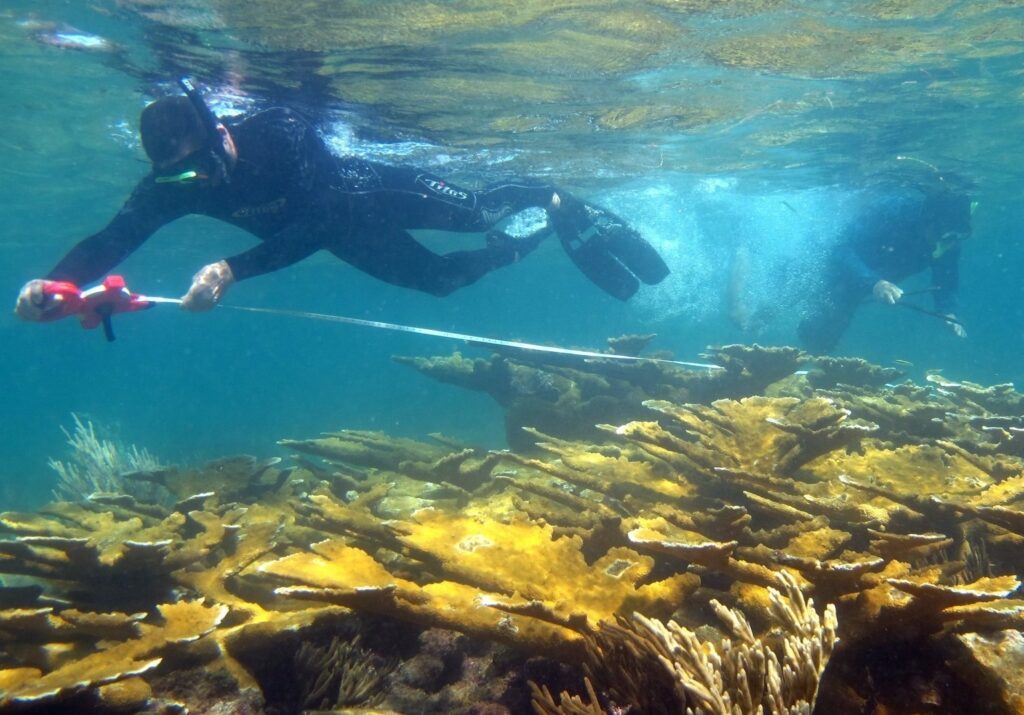
The Puerto Rico Long-term Coral Reef Monitoring Program has been conducting reef monitoring assessments since 1999. This program provides important data that supports coral reef management and conservation. In 2023, this program added water quality sampling to its monitoring protocol to better address knowledge gaps in how water quality issues impact local reefs.

Puerto Rico has been conducting coral reef restoration for many years. These efforts began as emergency restoration efforts aimed at removing shop paint from the sea floor and reattaching destabilized coral colonies and rubble. Today, reef restoration efforts include over ten in situ and three land-based nursery facilities. Hurricane Maria took a toll on Puerto Rico’s reefs, but several agencies, including FEMA, NOAA, and NFWF, have stepped in to fund reef recovery and restoration projects.

Puerto Rico’s Coral Program at the Department of Natural and Environmental Resources collaborates with partners to protect and manage watersheds such as Guánica and Culebra and aims to reduce land-based sources of pollution that flow into nearby coral reefs.

Each year, Puerto Rico hosts Coral Reef Week (la Semana de los Arrecifes de Coral) to celebrate coral reefs and raise awareness of their importance. Coral Reef Week includes educational events and activities such as snorkel tours, online webinars, field trips, and beach cleanups. During Coral Reef Week in 2023, over 50 activities were held island-wide, and over 600 community members participated. During Coral Reef Week in 2025, over 40 activities were held islandwide, and over 1000 participants and citizens were impacted.

The reefs of Puerto Rico are managed by the Puerto Rico Department of Natural and Environmental Resources (Departamento de Recursos Naturales y Ambientales), or DRNA. Puerto Rico is also a member of the All Islands Committee of the US Coral Reef Task Force.
Check out the Puerto Rico Department of Natural and Environmental Resources website to learn more about their work!
Connect with DRNA on social media @coral.puertorico



Other Resources to Explore
Coral Reefs of Puerto Rico (brochure)
Los Arrecifes de Coral de Puerto Rico (brochure)
Sources Cited
[1] The World Factbook – Puerto Rico
[3] AIC Chair’s Report to the USCRTF November 2024
[4] Puerto Rico DRNA Coral Disease Information
[5] New Hope for Puerto Rico’s Coral Reefs
[6] AIC Chair’s Report to the USCRTF August 2022
[7] AIC Chair’s Report to the USCRTF July 2023
[8] Arrecifes de Tourmaline Natural Reserve
[10] COP16 – New Marine Protected Area is a ‘victory for Puerto Ricans’